2026.08.14
 Industry News
Content
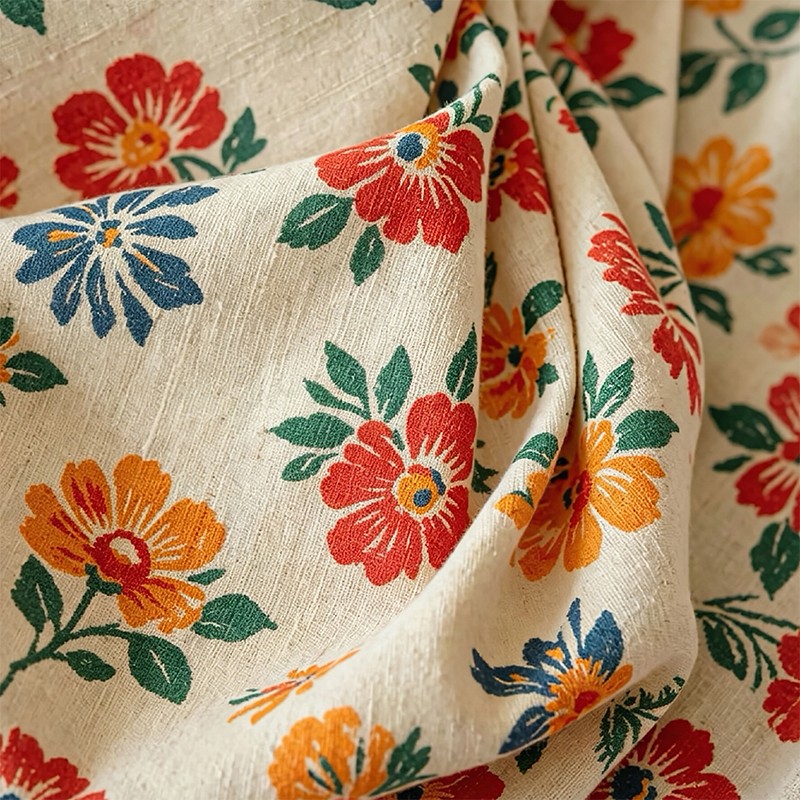
Fiber reactive fabric is fabric colored with dye that chemically bonds to the fiber itself, rather than sitting on top of it as a surface coating. The dye and the fiber form a covalent bond — a real chemical reaction, not just an attachment — which is why fiber reactive color resists fading, washing, and rubbing far better than pigment-based color. Reactive printing is simply this same chemistry applied through a printer: reactive ink is deposited onto fabric in a pattern, then steamed and washed so the color locks permanently into the fibers. It's the standard used for high-quality, long-lasting prints on cotton, linen, and other natural fabrics.
The term "reactive" refers to the chemical reaction between the dye molecule and the fiber molecule. Each reactive dye molecule carries a chromophore, the part of the molecule that absorbs certain wavelengths of light and reflects others — this is what produces the color you see. Under the right conditions of temperature and pH, that molecule reacts with the fiber and forms a covalent bond, one of the strongest and most stable types of chemical bond that exists. Once that bond forms, the color is part of the fiber's molecular structure rather than a layer applied to its surface.
Pigment-based color works differently: it sits on top of the fiber, held in place by a binder that acts something like a glue. That coating can crack, rub off, or fade with repeated washing, and it often leaves fabric feeling stiffer since there's an added layer on the surface. Fiber reactive color penetrates into the fiber instead of coating it, which is why it typically produces a softer hand feel alongside better durability.
Fiber reactive dye is formulated to bond with cellulose, so it performs best on plant-based (cellulosic) fibers. It can also be used on protein fibers like silk and wool with the right pre-treatment, but it is not suitable for most synthetics.
| Fiber Type | Examples | Compatibility |
|---|---|---|
| Cellulosic (plant-based) | Cotton, linen, rayon, hemp, Tencel, modal, bamboo | Excellent — the intended fiber type |
| Protein-based | Silk, wool, cashmere | Good, with proper pre-treatment |
| Synthetic | Polyester, nylon (standard) | Poor — not suitable for standard reactive dye/printing |
Reactive printing follows a consistent multi-step process, whether it's done on an industrial printer or a smaller studio setup. Each step matters — skipping or rushing any of them is the most common reason a print underperforms on wash-fastness or color vibrancy.
The right choice depends heavily on the fabric and how the finished product will be used.
| Factor | Reactive Printing | Pigment Printing |
|---|---|---|
| How color attaches | Chemically bonds inside the fiber | Sits on the surface, held by a binder |
| Wash durability | High — withstands repeated high-temp washing | Lower — prone to cracking and fading over time |
| Fabric hand feel | Soft, unchanged texture | Can feel stiffer due to surface coating |
| Best fiber types | Cotton, linen, natural/protein fibers | Broad range, including synthetics |
| Process complexity | More involved — requires steaming and multi-stage washing | Simpler — often just print and cure |
Because of its durability and softness, reactive-printed fabric is widely used across categories where both appearance and longevity matter:
If you're sourcing or specifying reactive-printed fabric, a few details determine whether you'll actually get the durability the process is known for:
 Wholesale Digital Printed Fabric Manufacturers
 English
 中文简体
中文简体 Español
 عربى
عربى